
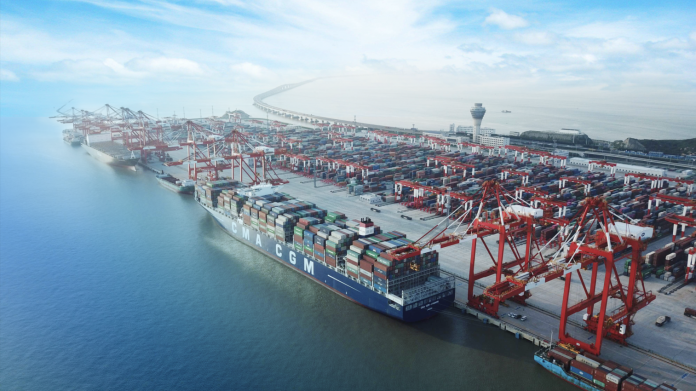

Shanghai remained the world’s busiest container port during the first half of 2026, according to Alphaliner’s latest ranking of the top 30 global container ports.
The Chinese gateway handled 28.737 million TEUs, representing growth of 6.2% compared with the first half of 2025.
Ningbo-Zhoushan moved into second place after handling 22.9 million TEUs, up 8.8%. The port overtook Singapore, which handled 22.742 million TEUs and recorded growth of 4.7%.
Shenzhen retained fourth place with 18.56 million TEUs, an increase of 7.7%.
Qingdao followed with 17.56 million TEUs, up 7.2%, while Guangzhou handled 14.03 million TEUs, representing growth of 2.9%.
Tianjin climbed from eighth to seventh place after its throughput increased by 6.1% to 13 million TEUs.
Busan slipped to eighth position. The South Korean port handled 12.601 million TEUs, down 0.7% year on year.
The combined Los Angeles and Long Beach gateway remained ninth with 9.975 million TEUs, representing growth of 2.8%.
Port Klang moved into tenth place with an estimated 7.7 million TEUs.
Tanjung Pelepas climbed from thirteenth to eleventh position after handling an estimated 7 million TEUs.
Rotterdam remained twelfth with 7.021 million TEUs, down 0.1%.
Antwerp-Bruges moved into thirteenth place despite a 1.5% decline to 6.804 million TEUs.
Hong Kong slipped to fourteenth after its throughput fell by 3.5% to 6.349 million TEUs.
Xiamen completed the top 15 with 6.035 million TEUs, representing growth of 1.6%.
Several South Asian ports posted some of the highest growth rates in the ranking.
Colombo climbed from 26th at the end of 2025 to twentieth in the mid-2026 ranking. The Sri Lankan port handled 4.444 million TEUs, an increase of 11.9%.
Nhava Sheva moved from 28th to 21st position after recording the strongest reported growth among the ranked ports.
The Indian gateway handled 4.403 million TEUs, up 13.6% from the first half of 2025.
Mundra ranked 26th with estimated throughput of 4.1 million TEUs.
Jakarta climbed from 27th to 23rd place after handling 4.3 million TEUs, an increase of 10.3%.
Cai Mep recorded growth of 9.2% to 3.9 million TEUs and ranked 29th.
Rizhao moved from thirtieth to 28th position after throughput increased by 8.1% to 3.955 million TEUs.
Laem Chabang handled 5.369 million TEUs, up 5.1%, while Lianyungang completed the top 30 with 3.4 million TEUs and growth of 0.3%.
Kaohsiung recorded the steepest reported decline among the top 30 ports. Its throughput fell by 5.4% to 4.275 million TEUs.
Beibu Gulf declined by 4% to 4.57 million TEUs.
Hamburg fell from 23rd to 27th place after container throughput decreased by 3.8% to 4.043 million TEUs.
New York and New Jersey handled 4.427 million TEUs, representing growth of 0.2%.
Alphaliner marked the first-half figures for Port Klang, Tanjung Pelepas and Mundra as estimates. First-half throughput figures for Tanger Med, Ho Chi Minh City and Haiphong were not available in the ranking.