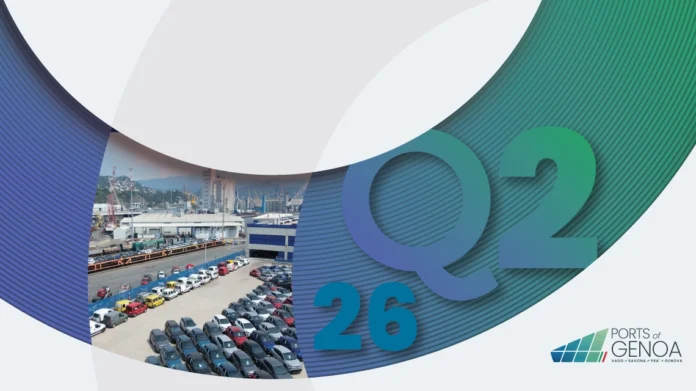

The Ports of Genoa and Savona-Vado handled 31.1 million tonnes of cargo in the first half of 2026, down 1.9% compared with the same period last year, as stronger gateway container and conventional cargo volumes helped offset weakness in other segments.
Container gateway traffic increased 1.6% during the first six months, while conventional cargo volumes rose 6.2%.
Total container throughput reached 772,534 TEUs in the second quarter, representing a 1% year-on-year increase.
Gateway container traffic performed more strongly, rising 5% in the second quarter and 1.6% during the first half of the year.
Full import containers increased 8.1% in Q2 and 6.3% during the January-June period. Meanwhile, total full containers moving to and from the hinterland increased 5.7% during the second quarter and 2.1% in the first half.
Transshipment traffic moved in the opposite direction. Volumes declined 16.4% in Q2 and 21.3% during the first six months, following strong growth in 2025.
As a result, overall container traffic at the Ports of Genoa and Savona-Vado reached 1,450,155 TEUs in the first half of 2026, down 2.7% year-on-year.
Containerized rail traffic also showed positive momentum during the period.
The number of trains increased 5.3% in the second quarter compared with the same period in 2025, in line with the growth in gateway container volumes.
Rail traffic involving Lombardy increased 12.6%, while volumes connected with Veneto rose 11.8%. Together, the two regions accounted for almost 70% of containerized rail services between the ports and their hinterland.
Conventional cargo volumes increased 7.2% in the second quarter and 6.2% during the first half of 2026.
Total volumes reached almost 6.7 million tonnes during the six-month period, supported particularly by growth in ro-ro traffic at both Genoa and Savona.
The ports handled 1.8 million passengers during the first six months of the year, representing a slight decline of 0.4%.
Cruise passenger numbers increased 2.7% to 1,078,699, while ferry passenger traffic declined 4.7% to 723,642.
The results came amid continued geopolitical uncertainty affecting major maritime routes and supply chain costs.