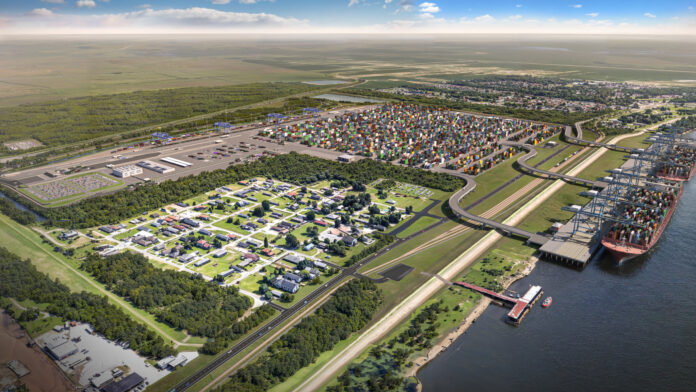

The U.S. Army Corps of Engineers has granted a federal permit for the Louisiana International Terminal (LIT).
The approval authorizes construction of the new deepwater container terminal.
Port of New Orleans (Port NOLA) is developing the project with private-sector partners. These include Terminal Investment Limited (TiL), the terminal operating arm of MSC, and Ports America.
LIT will be located on the Lower Mississippi River. It will have direct access to the Gulf.
According to Port NOLA, LIT is the only new greenfield container port currently under development in the United States.
The terminal will also have access to major rail and road networks. In particular, it will connect with every major Class I railroad and the interstate highway system.
As a result, Port NOLA said the terminal will connect more than 30 states with global markets.
The new terminal will be able to handle larger containerships.
According to Port NOLA, modern vessels now regularly exceed 16,000 TEU. However, ships of this size cannot pass under the Crescent City Connection Bridge.
LIT’s location will remove this restriction. Therefore, the terminal will allow Louisiana to accommodate larger vessels calling in the Gulf.
“This is not simply a regional port expansion — it is nationally significant infrastructure that will expand American export capacity and position Louisiana to lead the next generation of maritime commerce,” said Beth Branch, President and CEO of Port NOLA.
“We are ready to build,” she added.
The permit follows years of engineering and environmental review.
Ammar Kanaan, CEO of Terminal Investment Limited, described LIT as one of the company’s most strategically important terminal investments.
“The Mississippi River corridor gives the United States a chance to build deepwater capacity that rivals any port in the world,” he said.
Meanwhile, Ports America will bring its terminal operating experience to the project.
With the federal permit secured, Port NOLA and its partners will now move LIT into its next phase.
Port NOLA also highlighted the wider economic importance of its cargo operations.
According to an independent economic analysis cited by the port, its cargo activity supports more than US$101 billion in economic value nationwide.
It also supports more than 342,000 jobs across the United States. Of these, over 122,000 are in Louisiana.
At full buildout, LIT is expected to add thousands of jobs. The project is also projected to generate billions of dollars in new tax revenue across the country.