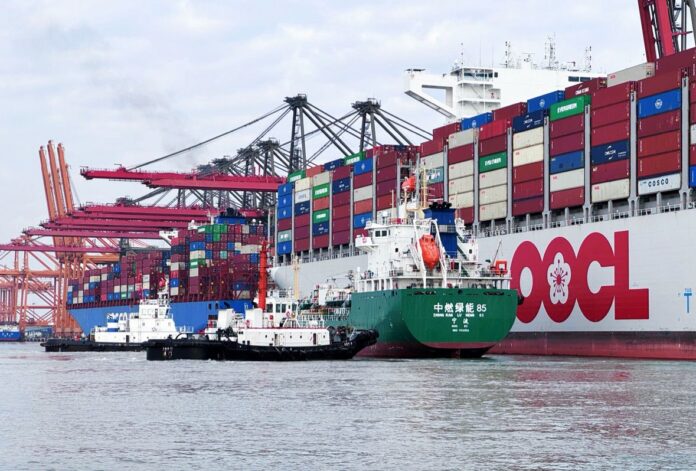

Xiamen Port in China has completed its first ship-to-ship green methanol bunkering operation, supplying 1,005 tonnes of the alternative marine fuel to OOCL WISDOM, one of the world’s largest methanol dual-fuel container vessels.
The operation took place on 4 November at Xiamen Yuanhai Container Terminal, marking the first green methanol ship-to-ship bunkering operation in China’s Fujian province and expanding the port’s capabilities in alternative marine fuel supply.
According to COSCO SHIPPING, the bunkering operation is estimated to deliver a reduction of more than 1,600 tonnes of carbon emissions compared with the use of conventional marine fuels.
The 24,168-TEU OOCL WISDOM is the first of seven methanol dual-fuel container vessels being introduced into OOCL’s fleet and operates on the carrier’s Asia–North Europe Loop 1 (LL1) service.
The vessel previously completed its first green methanol bunkering operation at Qingdao Port in July 2026, before commencing its maiden commercial voyage to Europe.
The latest operation at Xiamen represents a milestone for the port rather than the vessel, establishing the facility’s ability to provide green methanol through ship-to-ship fuel transfers.
According to information released by local port authorities, green methanol can reduce lifecycle carbon emissions by more than 85% compared with conventional marine fuels, depending on its production pathway and associated emissions.
The successful operation adds green methanol to Xiamen Port’s existing alternative fuel bunkering capabilities, which also include liquefied natural gas (LNG) and biofuels.
The development is intended to strengthen the port’s ability to serve container vessels equipped with alternative fuel propulsion systems as shipping companies expand their dual-fuel fleets.
COSCO SHIPPING said it would continue developing green marine fuel bunkering services through its activities in port operations, shipping and fuel supply.
Local port authorities are also working to improve operational standards and safety procedures to support the transition from initial green methanol bunkering operations to regular commercial services.