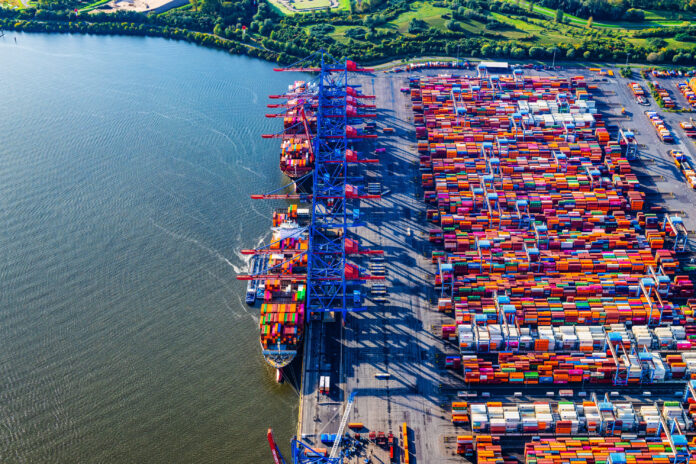

The Port of Hamburg steadied its cargo handling in the third quarter of 2026, partially offsetting the declines of the first half.
Total throughput at Germany’s largest seaport reached 84.5 million tonnes in the first nine months, 2.6% below the same period last year.
The shortfall stems mainly from weather-related losses at the start of the year, disruption in the global oil market following the war in Iran and, most recently, strikes.
Extensive modernisation work at the container terminals also weighed on results, but it is expected to strengthen the port’s performance and competitiveness and lay the foundations for future growth.
Container throughput improved markedly in the third quarter compared with the end of the first half. Over the nine months the port handled 6.1 million TEU, down 2.8% in TEU and 2.6% in tonnes.
TEU volumes rose with Singapore (+9.3%), India (+7.8%), Finland (+15.7%) and Sri Lanka (+3.7%).
Persistent trade barriers continue to hamper trade with the USA (-9.8%), while volume with China, the port’s largest trading partner, is almost back at last year’s level (-0.6%).
Many of the declines visible at the end of the second quarter were partly recovered during the third.
Bulk cargo totalled 23.9 million tonnes, down 2.6%.
Dry bulk continued to grow, up 1.7% on a significant recovery in grain exports and ore imports, partially offsetting a 13.3% fall in liquid bulk.
In other general cargo and vehicles, a positive third quarter reversed the earlier downward trend, with the segment now up 2% at a total of 853 thousand tonnes.