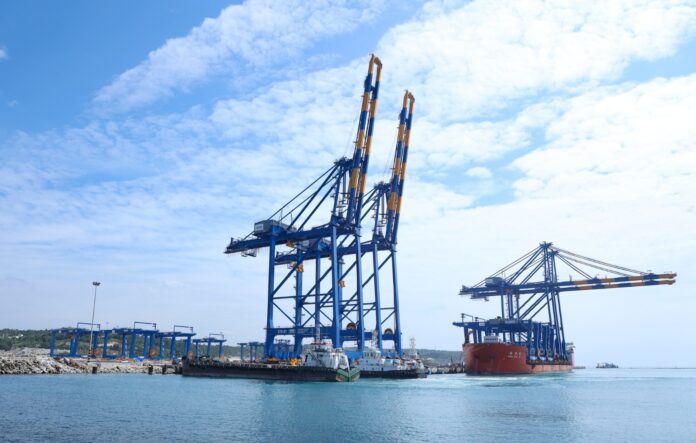

Vizhinjam International Seaport is moving beyond transshipment with the activation of full-scale export-import (EXIM) cargo operations, as the Indian port targets significant growth in gateway container volumes.
Vizhinjam aims to increase annual EXIM cargo from 0.15 million TEU to 1.5 million TEU over the next decade. The tenfold increase forms part of a wider strategy to strengthen the port’s role in India’s global maritime trade.
At the same time, Vizhinjam International Seaport Limited (VISL) is developing a wider logistics and industrial ecosystem around the port to support the shift towards gateway cargo.
The expansion into full-scale EXIM operations marks an important step in Vizhinjam’s development beyond its transshipment role.
To support the transition, VISL plans to develop a range of logistics infrastructure. This includes multimodal logistics parks, inland container depots, container freight stations and free trade warehousing zones.
Cold-chain facilities, truck terminals and fuelling stations are also included in the plans. On the maritime side, VISL envisages bunkering infrastructure, ship repair facilities, layby berths and other services.
The infrastructure is designed to support the movement of import and export cargo through the port and develop a broader logistics network around Vizhinjam.
VISL plans to develop around 3,500 acres for port-led industrialisation across three phases. The company is currently acquiring 230 acres for the first phase.
Over the next five to eight years, VISL aims to channel ₹1 trillion, approximately US$12 billion, into logistics and industrial development across southern Kerala.
The strategy covers a broad range of industries. Priority sectors include automotive and electric vehicles, food processing, renewable energy, chemicals and pharmaceuticals, consumer electronics and seafood processing.
VISL estimates that the wider development could create 100,000 direct jobs and 300,000 indirect jobs over the same period.
VISL has also signed memoranda of understanding with Indian Oil Corporation Limited (IOCL), Container Corporation of India (CONCOR) and Central Warehousing Corporation (CWC).
Together, the three central public sector enterprises are expected to invest ₹20 billion in maritime and logistics infrastructure around Vizhinjam.
According to VISL, IOCL is expected to invest ₹7 billion in an international bunkering terminal. CONCOR is expected to invest ₹6 billion, while CWC plans to invest ₹7 billion in storage and logistics infrastructure.
CWC’s plans include a 50-acre multimodal logistics park with cold-chain facilities and bonded warehouses.
The combination of full-scale EXIM operations, new logistics infrastructure and port-led industrial development is intended to expand Vizhinjam’s role beyond transshipment and establish the port as a gateway for Indian import and export cargo.