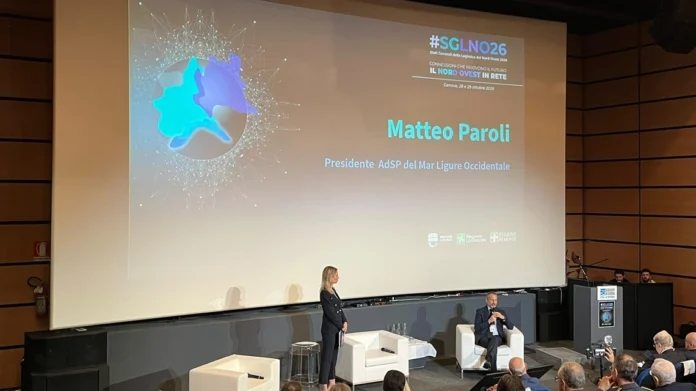

The Liguria Region, working with Lombardy and Piedmont, organised the two-day event “Connections Shaping the Future: North-Western Italy as an Integrated Network” in Genoa.
Rail carries about 30% of overland freight at Savona-Vado and 12.5% at Genoa, and the aim is to lift Genoa’s share to at least 30%.
The presidents of the three regions, Marco Bucci, Alberto Cirio and Attilio Fontana, attended, and Infrastructure and Transport Minister Matteo Salvini gave the closing address.
President Matteo Paroli of the Western Ligurian Sea Port Authority said the ports of Genoa and Savona-Vado are the main maritime gateway for 80% of manufacturing firms in Northern Italy.
They account for roughly 30 percent of Italy’s import VAT revenue and support 121,000 direct and indirect jobs. Paroli described the guiding vision as a port that generates wealth while minimising its impact on the surrounding urban area.
Genoa’s new open-sea breakwater, an investment of about EUR 1.4 billion, will receive ultra-large vessels of up to 400 metres by providing direct access and a wide turning basin in the Sampierdarena Basin.
Paroli stressed that such a project must sit within a wider logistics network, pointing to the forthcoming Terzo Valico high-speed, high-capacity rail line linking Genoa to Lombardy and the European hinterland.
Last-mile rail projects now nearing completion will allow the ports to handle intermodal trains of up to 750 metres and 1,750 tonnes per train with a single locomotive, which he called essential for an economically viable and sustainable rail service.
The authority has allocated about EUR 230 million to rail infrastructure at Genoa and Savona-Vado, covering IT upgrades, safety systems and electrification of intermodal areas.
To help, the authority is exploring incentives for terminal operators and closer coordination among logistics providers, manufacturers and public bodies.
It is also in talks with the Italian Customs Agency and other local authorities about extending operating hours, now 6 am to 6 pm, and is working with the road haulage sector to ease congestion.
Paroli added that congestion at major Northern European hubs and falling water levels on Europe’s main rivers could further raise the role of Mediterranean ports in international supply chains.