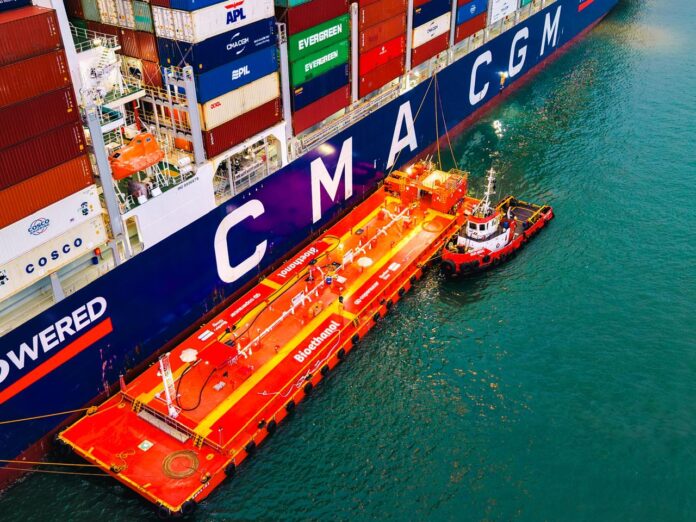

CMA CGM, Copersucar, Bunker One and the Santos Port Authority have launched regular ethanol bunkering operations at the Port of Santos in Brazil.
The first operation under the programme took place on 19 October 2026. It involved the 13,000 TEU containership CMA CGM Iron.
The vessel features the Everllence-B&W G95ME-C10.5-LGIM engine. According to the project partners, it is the world’s first certified tri-fuel marine engine capable of operating with ethanol.
The operation moves ethanol bunkering at Santos from an initial trial to a regular commercial supply model. Further deliveries to CMA CGM vessels are planned before the end of 2026.
Copersucar supplies the ethanol through its established and certified production chain. Evolua Etanol transports the fuel from Copersucar’s associated mills to the Port of Santos.
AGEO Terminais stores the ethanol at the port. Bunker One then manages the bunkering operation at the Santos Brasil terminal.
Bunker One developed a dedicated protocol for the operation after several months of preparation and staff training. The process considers ethanol’s low flash point and the specific safety requirements associated with its handling.
“The operation demonstrates that ethanol can be incorporated into maritime activities safely, reliably and at commercial scale,” said Giovani Grassi, CEO of CMA CGM Brazil.
He added that the initiative supports CMA CGM’s efforts to introduce fuels with lower carbon intensity and develop new energy supply chains for shipping.
Copersucar described the programme as the beginning of the world’s first maritime ethanol bunkering corridor.
“This marks a milestone for ethanol and shipping,” said Tomás Manzano, President of Copersucar. “It opens a new global destination market for the fuel.”
According to Manzano, the programme connects Brazil’s production and logistics capabilities with international demand for maritime decarbonisation.
The partners said global marine fuel consumption exceeds 270 billion litres annually. Based on energy equivalence, replacing 10% of that consumption could create additional demand for around 50 billion litres of ethanol per year.
The project partners also pointed to the growing number of vessels equipped with alternative-fuel engines.
Citing DNV data, they said 159 vessels currently operate with methanol-capable engines that can also use ethanol. More than 450 additional vessels with this technology are scheduled for delivery by 2030.
Flavio Ribeiro, CEO of Bunker One Latin America, said the initiative combines Brazil’s ethanol production capacity with Bunker One’s international marine fuel network.
Anderson Pomini, President of the Santos Port Authority, described the operation as a step towards a new phase of sustainable port and maritime development.