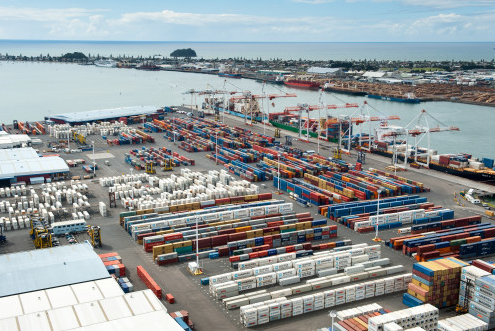

Port of Tauranga reported a record underlying profit for the financial year ending 30 June 2026, supported by higher productivity, cost reductions and yield improvements.
Underlying group net profit after tax increased by 23% to $155.3 million from $126 million.
Reported group net profit after tax reached $156.1 million, down 10% from $173.4 million in the previous year. The FY25 result included a one-off gain of $49.2 million from the sale of Northport shares.
Revenue and EBITDA increase
Port of Tauranga’s revenue increased by 4.7% to $486.5 million.
EBITDA rose by 17.6% to $275.7 million, while operating costs declined by 6.2% to $221.7 million.
The company declared a total ordinary dividend of 20.5 cents per share, representing an increase of 22.8%.
“This is a strong result, achieved against a backdrop of difficult economic conditions, lower trade volumes and ongoing berth capacity constraints,” said Julia Hoare, Chair of Port of Tauranga.
“The strengthening of the business has allowed directors to declare a 22.8% increase in dividends for the full year,” she added.
Container throughput remains stable
Total trade decreased by 3% to 24.6 million tonnes due to lower log and coal volumes.
Exports declined by 3.3% to 15.9 million tonnes, while imports fell by 2.3% to 8.7 million tonnes.
Container throughput increased by 0.4% to 1,213,494 TEUs.
Export container volumes rose by 2.4% to 512,765 TEUs. Import containers increased by 2.5% to 411,340 TEUs.
However, transshipment volumes declined by 5.5% due to changes in shipping services and berth capacity constraints.
Crane productivity improves
Average crane productivity increased by 9.9% to 30.8 container moves per hour.
Ship rates improved by 13.6% to 76.5 moves per hour. Meanwhile, the share of vessels arriving on time rose from 62% to 71%.
“We’re seeing good improvements in service delivery to our customers, with our average crane productivity increasing 9.9% to 30.8 moves per hour, and ship rates increasing 13.6% to 76.5 moves per hour,” said Leonard Sampson, Chief Executive of Port of Tauranga.
“These improvements were supported by on-time vessel arrivals climbing from 62% to 71% over the previous year,” he added.
Ship visits increased by three to 1,445, while cruise ship calls declined by 16% to 79.
Dairy and kiwifruit support reefer volumes
Log exports declined by 8.1% to 5.8 million tonnes. Port of Tauranga linked the decrease to higher fuel costs, which prompted some exporters to reduce harvesting during the second half of the financial year.
Direct dairy exports increased by 3.9% to 2 million tonnes.
Kiwifruit exports rose by 8.5% to a record level. Growth in dairy and kiwifruit shipments contributed to record refrigerated export container volumes.
Oil product imports declined by 2.4%. Fertiliser imports increased by 1.2%, while stock feed volumes rose by 0.6%.
Imported coal volumes fell by 64.8% as Huntly Power Station’s stockpiles stabilised and South Island hydro generation met winter demand.
Port invests in capacity and automation
Port of Tauranga is continuing the second stage of its dredging programme to accommodate larger vessels.
The project will deepen the port’s shipping channels and is scheduled for completion by mid-2027.
The port is also preparing to introduce electric automated stacking cranes. Following a dynamic simulation project, it has started contract negotiations with its preferred supplier.
The first stage of the automation programme will coincide with the planned berth extension at the container terminal.
In early August, the port received six additional hybrid straddle carriers and New Zealand’s first fully electric straddle carrier.
These units joined seven hybrid straddle carriers already in operation. The hybrid equipment is around 25% more fuel-efficient than older diesel-electric models.
The port’s first hybrid tug is under construction in Türkiye and is scheduled for delivery in mid-2027.
Stella Passage decision expected in September
Port of Tauranga said its existing container terminal is effectively operating at capacity and cannot accommodate additional shipping services because of limited berth availability.
The Stella Passage development will convert existing cargo storage land into berths on both sides of the harbour.
On 17 August, the fast-track panel released a draft decision proposing approval of the project, subject to conditions.
A final decision is expected in early September.
“This is critical national infrastructure that will pave the way for the next stage of growth at the port and for all of its cargo customers,” said Hoare.
Port forecasts further earnings growth
Port of Tauranga expects capacity constraints to continue until the Stella Passage development is completed.
The company also expects conflict in the Middle East to keep affecting fuel prices in the near term, placing pressure on diesel-dependent export industries such as forestry.
Subject to trading conditions and events beyond its control, the port expects underlying earnings of between $160 million and $175 million in FY27.
Port of Tauranga will provide a first-quarter trading update and further earnings guidance at its Annual Meeting of Shareholders on 29 October 2026.