
Associated British Ports has installed new pinning stations at its Humber container terminals in partnership with local supplier Grimsby Pipework and Engineering Ltd, addressing one of the highest-risk operations on busy container terminals.
Four stations have been installed at the Port of Immingham, with a further four to follow at the Port of Hull.
Pinning operations, which involve operatives removing twist lock pins from the four corners of containers as they sit on trailers, represent a significant safety challenge due to exposure to overhead hazards and surrounding vehicle movement.
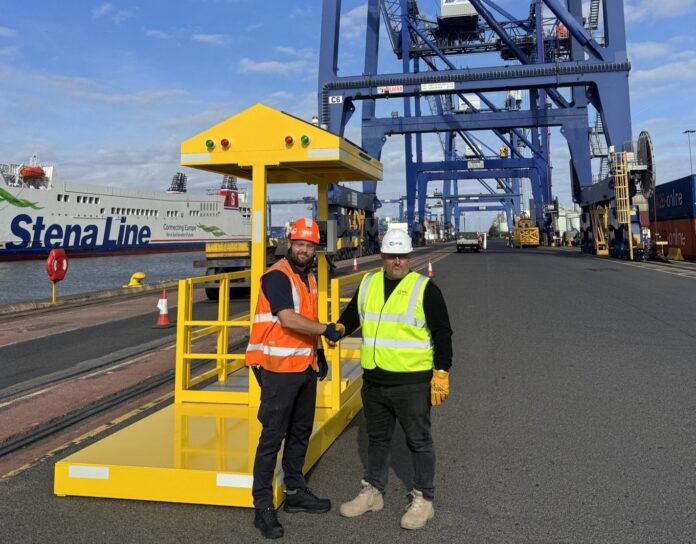
The new stations are positioned offset from the vessel within marked areas, physically protecting pinners from these risks.
Red and green signal lights indicate when container transfer tugs can safely enter the pinning zone, and the stations are fabricated to allow pinners to safely reach pins from within the protected structure.
The system also eliminates twist locks being left on the ground, removing a hazard to tugs and a trip risk for operatives.
The stations were developed through close collaboration between ABP’s safety and operations teams, with GPE conducting a site survey before designing and fabricating bespoke units sized to fit the quayside and compatible with the forklifts in use.
The project reflects ABP’s Continuous Improvement ethos and the direct involvement of frontline operatives in the design process.
Jamie Pearson, Head of Unitised at ABP Humber, described the stations as purpose-built to eliminate the risks previously faced by pinners.
Mike Hemsworth, Managing Director of GPE, highlighted the combination of ABP’s operational knowledge with GPE’s design and manufacturing capabilities as a model of collaborative engineering focused on protecting workers in a demanding port environment.
The Ports of Hull and Immingham together welcome 24 vessels per week and handle more than 5,500 units weekly as the leading northern England gateways for short sea container traffic with Europe and the Baltic.