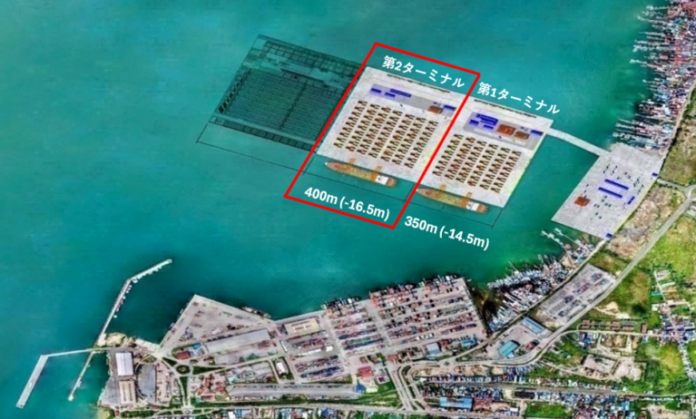

Toyo Construction has secured a ¥26.2 billion contract to build the second new container terminal at Sihanoukville Port in Cambodia.
The Port Authority of Sihanoukville awarded the Japanese contractor Package 1, which covers the civil engineering works for the NCT2 expansion project. Construction is expected to take 36 months.
According to Toyo Construction, this will be its largest project undertaken in Cambodia. The development will be financed through a Japanese government yen loan provided by the Japan International Cooperation Agency.
The project includes the construction of a 400-metre quay with a width of 35 metres and a water depth of 16.5 metres.
Toyo Construction will also develop approximately 200,000 square metres of container terminal space. Other works include 3.9 million cubic metres of dredging, 350,000 cubic metres of land reclamation and 900 metres of revetment.
The contractor will construct 12 buildings with a combined floor area of 9,389 square metres. The scope also covers yard development, electrical infrastructure and equipment-related works.
A new terminal operating system will manage cargo handling, container storage, gate checks and transport services. Once completed, NCT2 is expected to increase Sihanoukville Port’s annual handling capacity by approximately 450,000 TEU.
Sihanoukville is Cambodia’s only deep-water port and serves as the country’s main maritime gateway. Cargo volumes have increased alongside Cambodia’s economic growth, placing pressure on the existing terminal infrastructure.
Three new container terminal projects are currently being developed at the port with support from the Japanese government and JICA. Toyo Construction’s latest contract covers the second terminal in this wider expansion programme.
The Japanese contractor has operated in Cambodia since opening its Phnom Penh office in 1997. It previously participated in the Sihanoukville Port Multipurpose Terminal Development Project, which was completed in 2018.